A busy website can still leave the business unchanged. Page views, scrolls and downloads tell you something happened. They do not establish whether the right people found value.
Define the website’s job first. For B2B, follow enquiries into qualification and sales conversations. For commerce, examine completed orders, returns and contribution. For public services, review successful task completion and support demand.
Connect stages without pretending the website caused everything. A prospect may hear about you at an event, read a case study and return through search. Attribution describes observable touchpoints; it cannot reconstruct every influence.
Use a small set of measures to support decisions. If relevant visits are rising but enquiries are not, examine fit, evidence and friction. If enquiries rise but qualification falls, inspect the offer and acquisition sources.
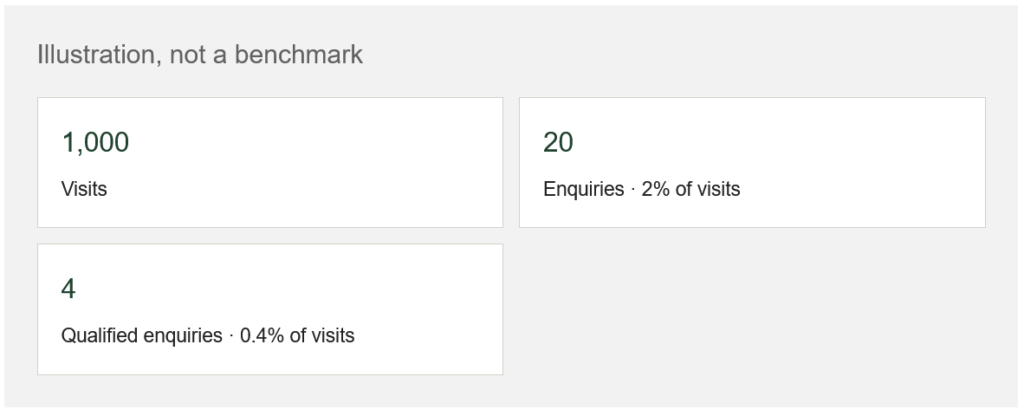
An illustrative calculation: 1,000 visits producing 20 enquiries gives a 2% enquiry rate. If only four meet your qualification criteria, the qualified-enquiry rate is 0.4%. Those are different signals, and neither is an industry benchmark.
Give the website and sales teams a shared definition of a useful enquiry. Without that agreement, the dashboard can look healthier while the work becomes less productive.