A long visit is not automatically a good visit. Someone may be comparing useful evidence, or searching in circles for your contact details. Interpret time alongside the task.
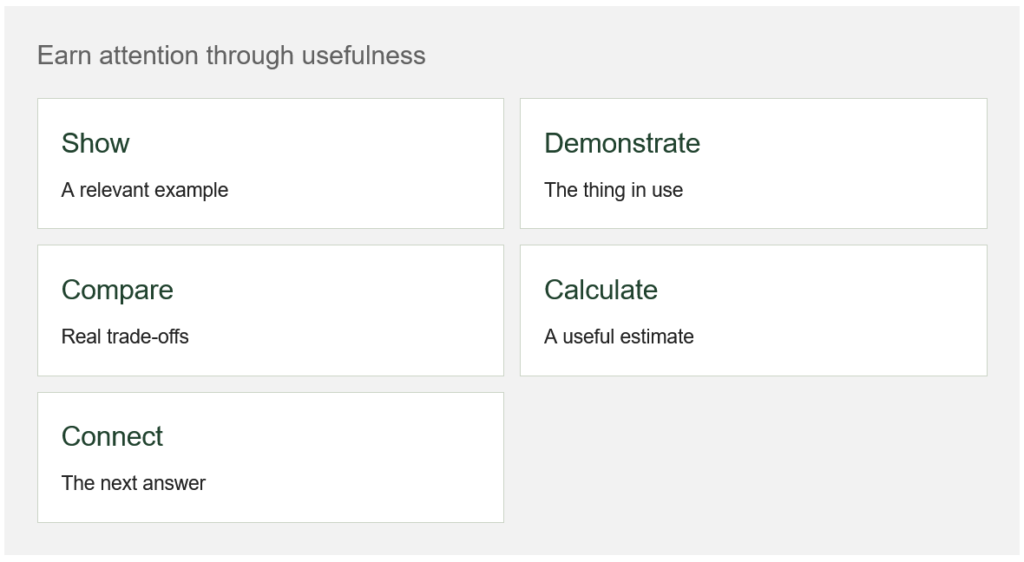
Offer five reasons to stay: a relevant worked example; a demonstration that answers a practical question; a comparison that explains trade-offs; a simple decision tool; and contextual links to the next useful answer.
Avoid padding the journey with unnecessary clicks or hiding basic information behind a download form. The aim is to make investigation rewarding while keeping straightforward tasks fast.
An influential 2008 Nielsen Norman Group analysis estimated that visitors would typically read around 20% of the words on an average page. It is historical research, not a current universal reading rate. Its durable lesson is to make pages useful to people who scan.
Use descriptive headings, short sections and clear captions. Let the reader recognise the answer before deciding whether to explore it.
Choose a meaningful companion measure for each addition. A calculator might support a qualified enquiry. A demonstration might reduce support questions. A shorter visit that ends in successful task completion can be progress.
A number worth understanding
~20%
Estimated typical share of words read in NN/g’s 2008 analysis. Historical context; not a prediction for every visitor or page.
Source: Nielsen Norman Group, How Little Do Users Read?, 2008